Overview
The City is rehabilitating and improving the roadway around Bert Fleming Park to make it safer and easier to use for everyone, regardless of how they travel.
To increase efficiency and reduce costs, this work is bundled with other road improvement and renewal projects. This means that construction only needs to happen once.
All roads have a limited lifespan and eventually need to be resurfaced or rebuilt. When that time comes, the City also checks if the road still meet’s today’s safety and accessibility standards.
In this case, the original rotary (often called a “traffic circle” by the community) around Bert Fleming Park doesn’t meet modern safety standards. The original road design:
- Fails to slow down traffic
- Is missing pedestrian crossings
- Causes confusion for drivers and access issues for nearby properties
These safety concerns, along with the need for resurfacing, triggered the full redesign of the area.
This project will deliver:
- Rehabilitated roads
- Improved intersections
- Increase road safety
- New transit infrastructure
- Renewed landscaping
This project also supports the City’s Vision Zero Action Plan by protecting vulnerable road users and making it easier for people get around by walking, cycling, taking public transit or driving.
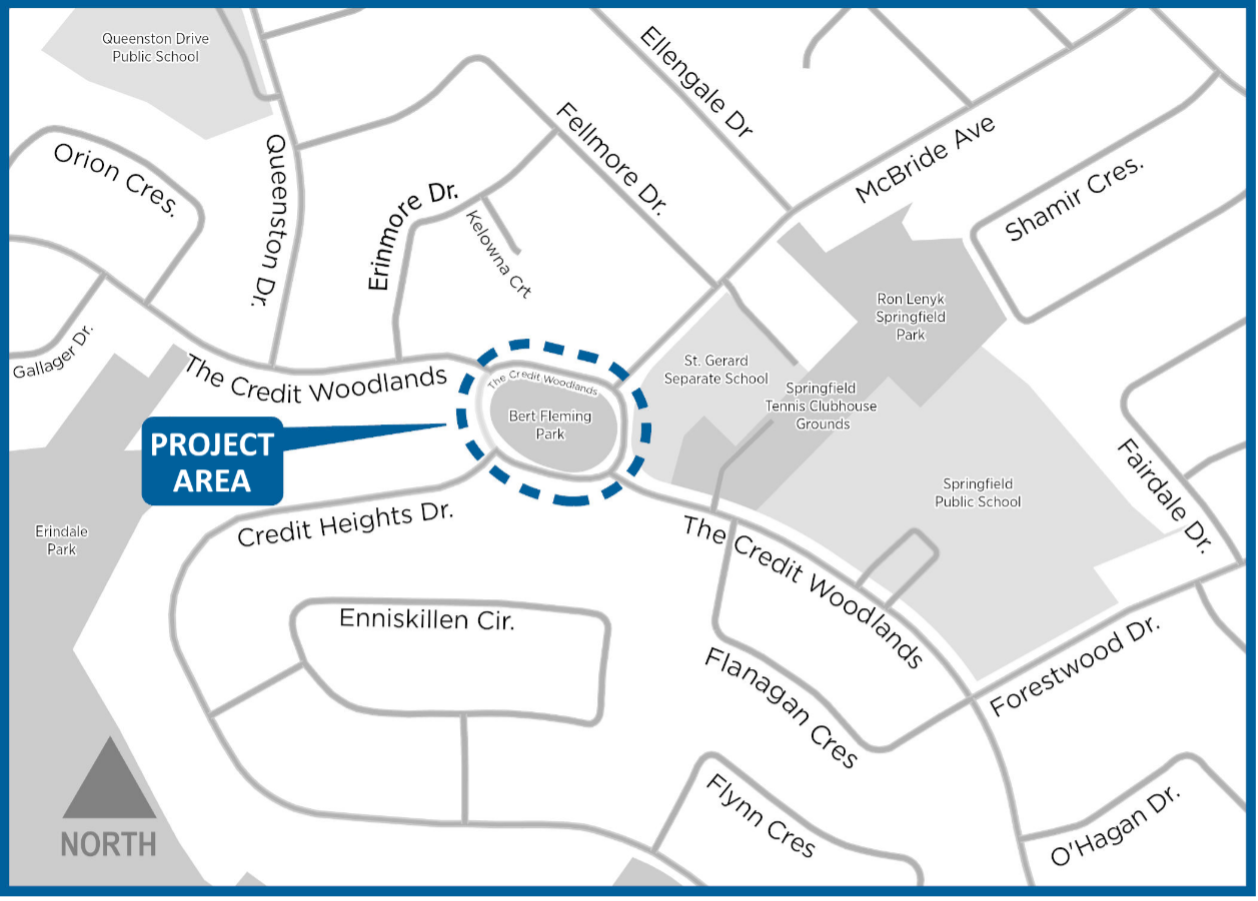
Map of the project area, which includes the roads directly surrounding Bert Fleming Park. Study and public consultation completed. Preferred design selected. Includes field investigations, permits and approvals, contract documents, and awarding of the construction contract. Major work on The Credit Woodlands and McBride Avenue, expected to be completed by early September 2025. Restoration work has been completed, with the exception of sod installation in the permanently closed section of The Credit Woodlands. Sod placement in this area has been rescheduled for spring 2026.
Milestones are based on the anticipated project timeline. Construction schedule is tentative and subject to change based on weather and other factors.
Construction updates
January 2026
- Existing street light poles have been disconnected and removed.
December 2025
- Electrical installation inspections have been completed, and all required approvals have been obtained.
- Site winterization measures have been implemented to manage sediment control and enhance site safety, including the installation of silt fencing and snow fencing.
- Sod installation in the permanently closed section of The Credit Woodlands has been rescheduled to spring 2026 due to weather conditions and other contributing factors.
November 2025
- Restoration work, including driveway repairs and the placement of topsoil and sod, are complete, except for the permanently closed west section of The Credit Woodlands.
- The topsoil and sod placement in the permanently closed section is dependent on weather conditions and other factors.
- We appreciate your patience and cooperation as we finalize these improvements.
October 2025
- All major works, including infrastructure relocations, concrete and asphalt works, and electrical installations, are complete.
September 2025
- The east section of The Credit Woodlands is opened to traffic. Please follow traffic control measures on site.
- The west section of the Credit Woodlands, which was used as a temporary detour, is now closed to traffic. Please follow traffic control measures on site.
- MiWay has resumed the original bus route
Completed works
- Construction of the northern and southern mini-roundabouts.
- Asphalt paving on McBride Avenue and around the northern mini-roundabout.
- Base layer of asphalt on the east section of The Credit Woodlands. This section of road is now open to traffic.
August 2025
- Major construction work has commenced.
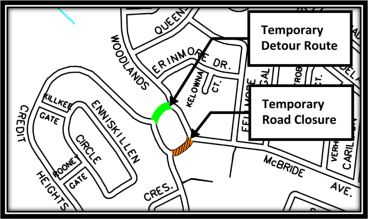
- Contractor has implemented temporary traffic control measures. Vehicle lanes will be reduced to one lane in sections within the project area. Intersection closures may be required during roundabout installation and detour signage will be installed. Please follow traffic control measures on site. Motorists can expect delays. Plan destinations accordingly and use alternate routes where possible.
Note: The previously closed road section west of Bert Fleming Park has been temporarily opened to serve as a detour route to accommodate construction activities on the road section east of Bert Fleming Park. Please see image below.
July 2025
- Construction Contract awarded.
- Contractor initiated the site preparation works, including installation of tree protection, pest control and sediment control measures.
Background
In summer of 2023, as part of the Sharing Lanes project, we made temporary design changes to the roadway. Changes were based on community feedback, and they led to these results:
- Replacing two traffic islands with all-way stops changed how cars move around Bert Fleming Park.
- Adding six new crosswalks helped to connect the park with two nearby schools and improved the safety of students and families walking to and from school.
- Converting the west portion of the rotary into a car-free plaza provided new space for locals to use as an extension of the park.
What we heard from residents
Community feedback on the impact of temporary changes was mixed, but showed several key themes. Residents appreciated:
- Improved pedestrian crossing
- Reduced traffic speed
- The car-free plaza (particularly liked by children and families)
Residents also raised concerns about:
- Traffic delay at new all-way stops
- A desire to see the neighbourhood character returned to its original look, such as standard pavement markings and signage
- Mixed feelings about road art
These insights directly informed the permanent design, which prioritizes the safety and accessibility of all road users, while respecting the character of the neighbourhood.
Design alternatives
The City and an engineering consultant completed a detailed analysis of the roadway around Bert Fleming Park and determined it can’t be restored to its previous state. This conclusion was made through an independent review done by external consultants.
Together we considered 10 design alternatives, which are options for completing an infrastructure project. Two were shortlisted based on community feedback.
A roundabout with specific design and traffic control features, such as:
- Large entry angles
- Crosswalks
- Splitter islands
- Parking restrictions
- No driveway access
This design:
- Meets modern-day standards
- Make the road safer
- Slows down cars when they enter and exit the road around Bert Fleming Park
But it would also:
- Impact resident access to driveways, making it not technically feasible
- Cause us to lose Bert Fleming Park, including the opportunity to redevelop it to benefit the community
- Require significant and costly modifications to the road, related infrastructure and utilities
For these reasons, we determined this design is not feasible.
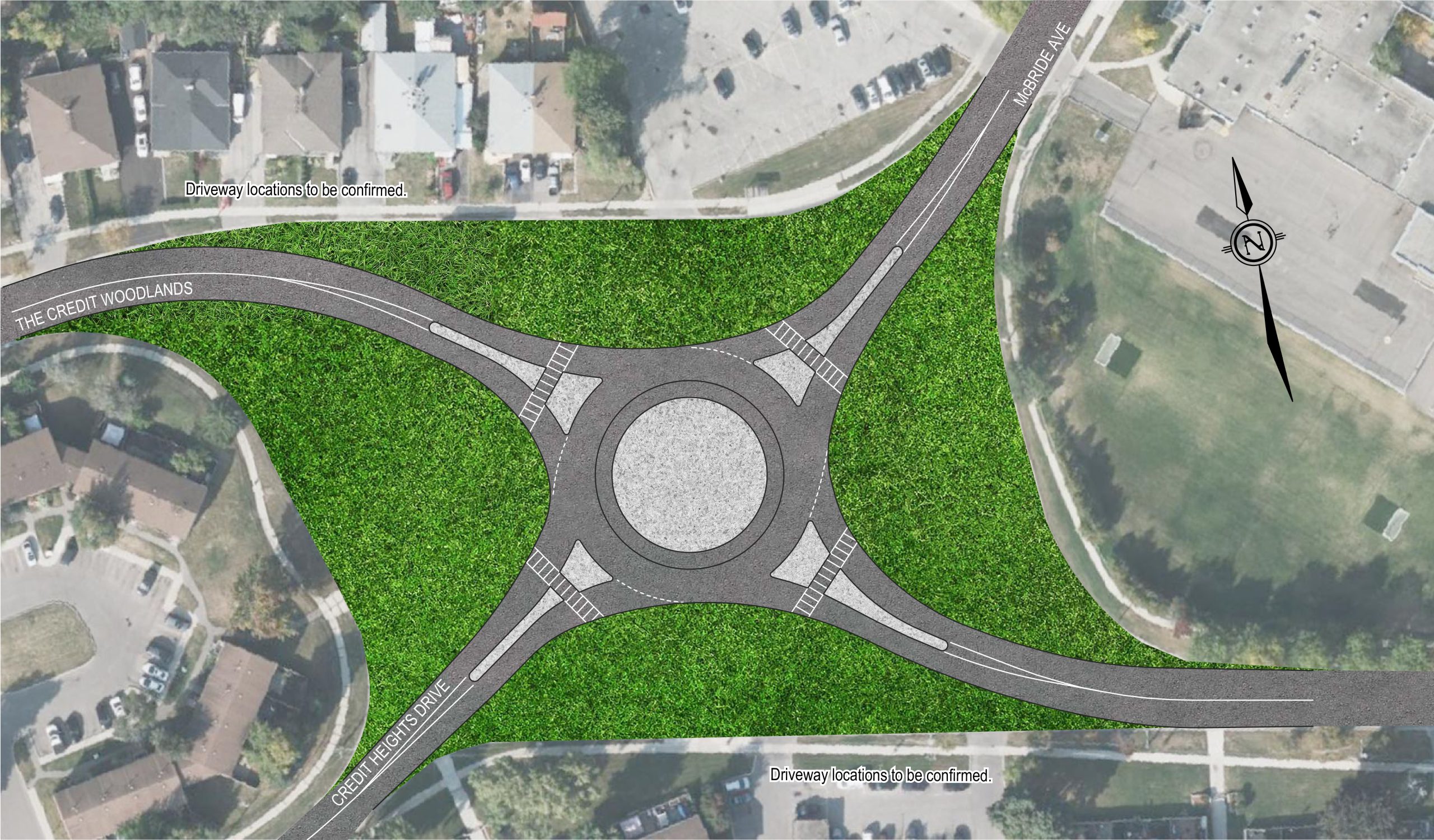
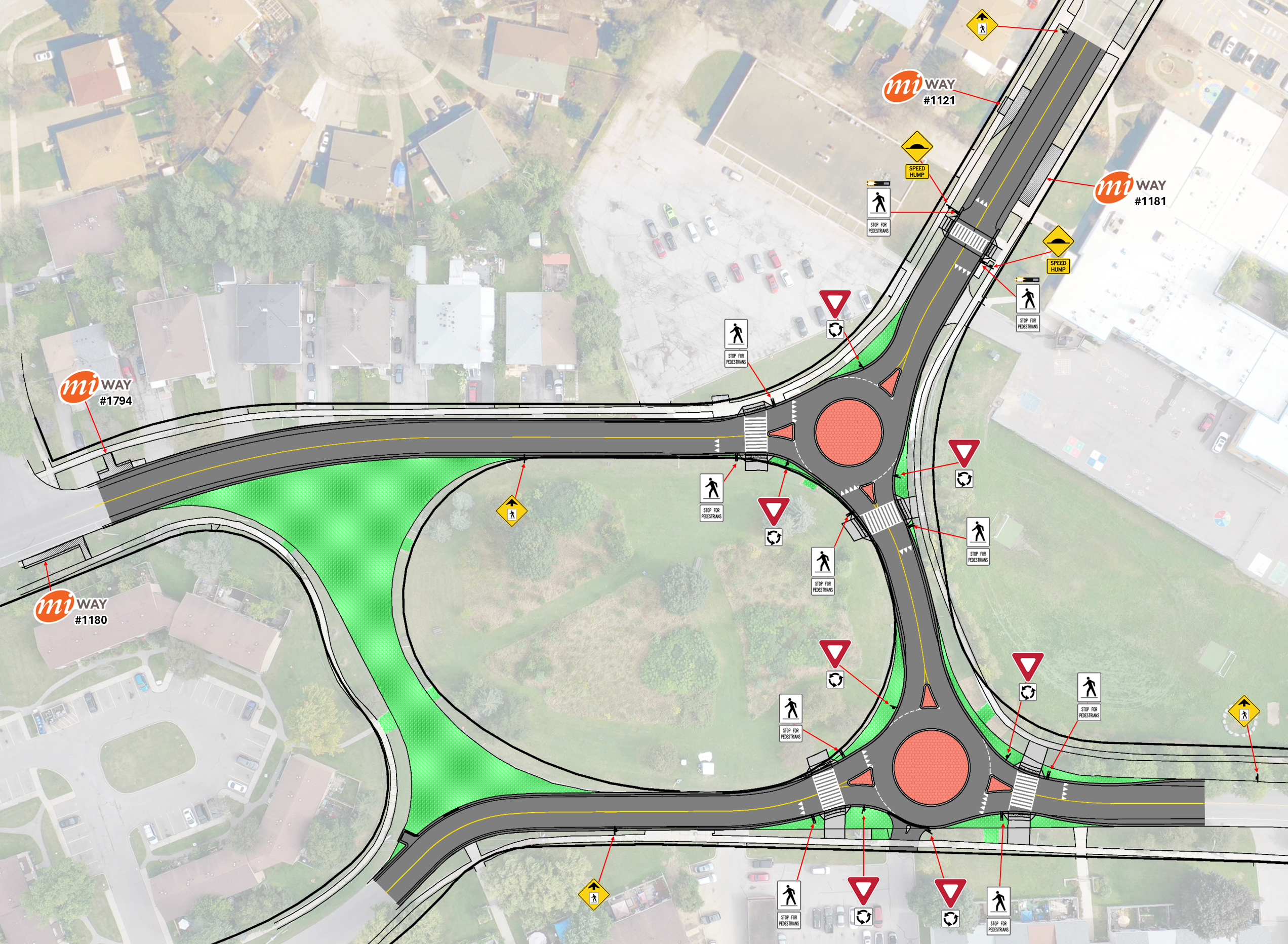
This alternative features a modification of the original configuration, introducing two-way traffic and two mini-roundabouts on the east leg.
This design:
- Uses the same road right-of-way without widening the current roadway
- Meets modern safety requirements of a full-size roundabout while fitting into a circular diameter of 27 metres or less
- Prevents the need for vehicles to come to a full stop unless necessary with yield control
- Reduces speeding and improves traffic flow
- Doesn’t restrict access to driveways, like a roundabout design would
- Restore the neighbourhood’s character to resemble its original state
- Grants everyone with access to the existing green space, which could be developed in the future to benefit the community
Why we selected this design:
We chose this design because it meets safety and operational requirements, doesn’t impact Bert Fleming Park, and balances the community’s desire for free-flow traffic conditions, traffic speed and safe pedestrian crossings.
Questions and answers
The Credit Woodlands integrated road project was designed to improve safety, support smoother traffic flow, and make roads easier for people to use.
It follows several well-established guidelines, including:
- The Transportation Association of Canada’s Geometric Design Guide for Canadian Roads and The Canadian Roundabout Design Guide
- The City of Mississauga’s engineering standards and drawings
It also supports the City’s Vision Zero Action Plan, which aims to eliminate traffic-related deaths and serious injuries.
The mini-roundabouts are designed to fit within the existing road space, so no widening is needed. This helps calm traffic, improve safety, and maintain connectivity. One of the mini-roundabouts connects to a private access, improving fire truck accessibility to better serve the community. The design follows national guidelines to ensure safe operation, including:
- Considerations for sightlines
- Entry curvature
- Traffic separation (spitter island)
- Driveway configuration
The crosswalk on McBride Avenue is used by students and families at nearby St. Gerard Elementary School. It was relocated closer to the school to better align with where people naturally tend to cross, support the City’s crossing guard program, and meet accessibility standards.
The new location makes crossing the street easier and safer for pedestrians, improves visibility for drivers, and makes it more comfortable for everyone.
To further support traffic calming efforts, the McBride Avenue crosswalk will include:
- A raised platform to slow down vehicles
- Pedestrian signs and flashing lights that activate only when someone press the push-button, helping drivers see people crossing
An independent review of the original rotary by external consultants confirmed:
- The original configuration allows vehicles to travel at high speeds, making the roadway less safe to use.
- The lack of controlled crossing facilities for pedestrians and cyclists makes crossing the street inaccessible.
- Although there are yield signs, because the road is wide enough for two lanes, drivers don’t get clear visual cues to yield to cars already in the rotary when entering.
- Drivers in the rotary may not have a clear enough view to see cars going in and out of the driveways that open directly into the rotary.
- Drivers who don’t know the area well might exit a driveway, into the rotary, thinking there is two-way traffic and end up driving the wrong way.
A single roundabout is not feasible because:
- It compromises driveway access for existing residents
- The cost would be significantly high
- The City would be unable to complete construction before the project deadline (Fall 2025).
Various placement options for the roundabout were considered, including shifting it northward or southward. However, none of these options met the necessary technical feasibility requirements.
The Credit Woodlands has been identified as a roadway that would benefit from traffic calming measures due to concerns from local residents and data confirming speeding issues. A preliminary plan is being developed for review by the local Ward Councillor and the impacted residents.
As part of this process, City staff will aim to address speeding concerns and coordinate the work with future improvements to the roadway around Bert Fleming Park.
About traffic calming
Traffic calming refers to physical measures installed to improve safety for road users, particularly by reducing speeding and encouraging safer driving. These measures can be retrofitted on existing roadways or implemented as part of a redesign project.
The City adheres to its Traffic Calming Policy, which outlines the types of roadways and conditions where traffic calming would be considered. It also specifies the process for traffic calming projects, including the requirement for public consultation before staff recommend a project.
Bert Fleming Park spans 7,106 square metres (approximately 1.76 acres), and includes open passive space, naturalized areas and trees.
Historically, the park was not easy for the public to use because it lacked access points that pedestrians can use.
The 2024 Parks, Forestry and Environment Plan aims to make it easier for people to access parks by creating better connection points. The City is interested in reviewing potential improvements to Bert Fleming park to enhance its functionality and usability.
Based on the outcome of The Credit Woodlands Integrated Road Project, the City’s Parks, Forest and Environment staff will consider further developments of the park by consulting with local residents. The long-term vision for the park is to make it easier for park users to access, expand its functionality and provide opportunities for park programming.
Central Island
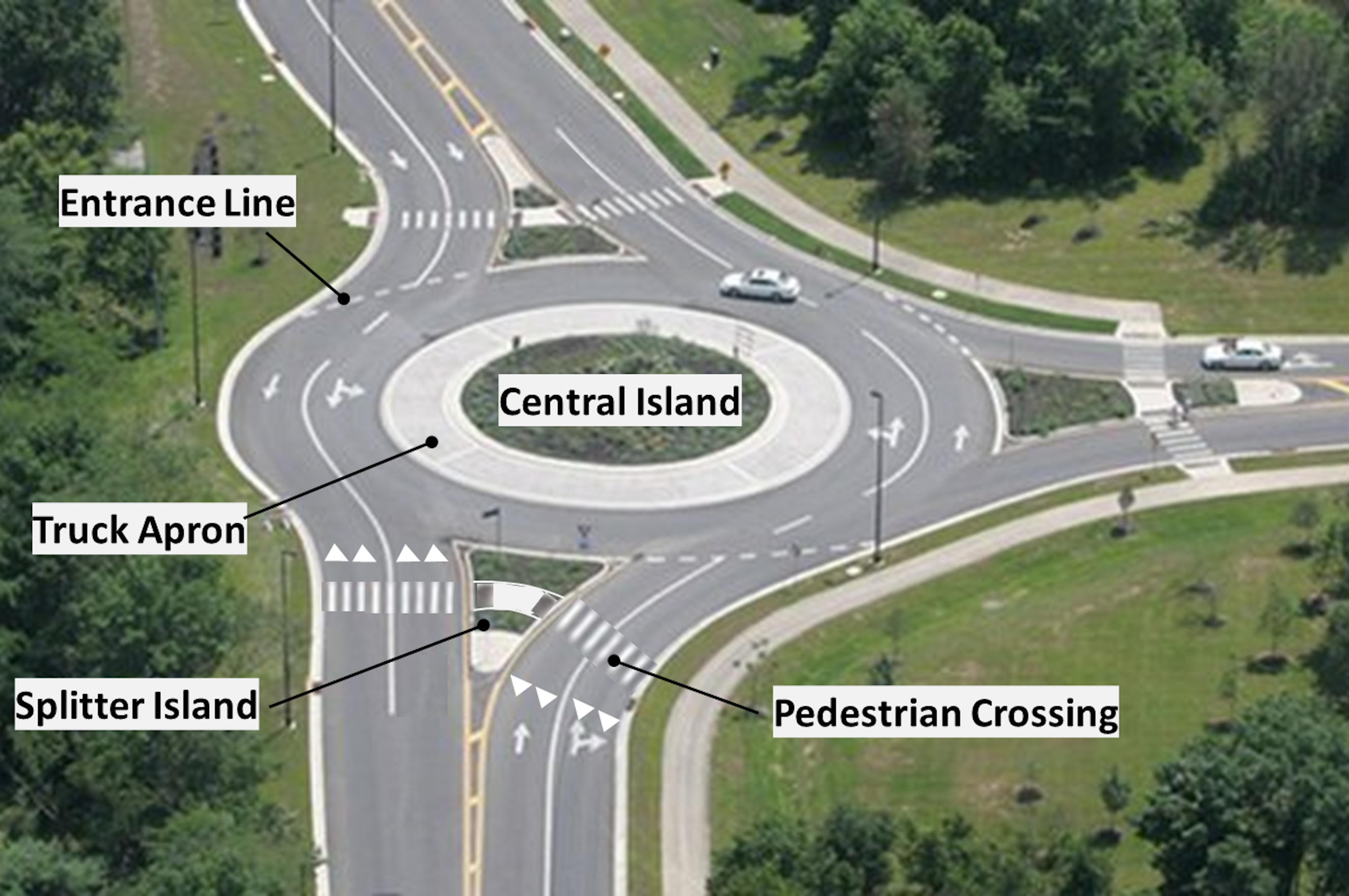
A raised area in the centre of the roundabout that the roadway travels around. Central islands are not always circular in shape. Engineering guidelines allow mini-roundabouts to accommodate all types of traffic, including larger trucks and buses.
Splitter island
Raised or painted areas between the entry and exit lanes of an intersection that separate traffic. They make cars slow down and can be designed to give pedestrians a safer, two-stage crossing.
Truck apron
A flat, hard-surfaced part of a central island next to the main road inside the circulatory roadway, with a low-curb that trucks can drive over if needed. They can also be placed on the outside of the circulatory roadway at entrances and exits.
Entrance line
Dashed line that marks the point of entry into the circulatory roadway.
Pedestrian crossings
Pedestrian crosswalks in roundabouts are placed before cars enter and after they exit the roundabout. The splitter island is designed to let pedestrians safely cross through. They should be accessible and easy to use with signs, slopes and textured surfaces.
The main differences between a roundabout, mini-roundabout, traffic circle and rotary are the size, the speed vehicles can travel, and what they’re use for.
Roundabout
- A modern circular intersection where vehicles go counter-clockwise around a central island.
- Vehicles entering the roundabout must yield to traffic already in the roundabout.
- Has specific geometric design and traffic control safety features that improve safety and traffic flow.
Mini-roundabout
- A smaller roundabout but with fully traversable central and splitter islands. This means that large vehicles (such as buses and large trucks) can safely drive over parts of the central and splitter islands when going through the mini-roundabout.
- Commonly used tight spaces or in low-speed urban environments, where a typical single-lane roundabout can’t be placed.
Traffic circle
- An old-style circular intersection typically constructed in urban areas.
- Often equipped with traffic signals or stop signs to control one or more entries, or to facilitate high pedestrian volumes.
- Statues or monuments are often located within the large central island.
- Typically have smaller entry angles that allow for higher speeds at entry.
- May have splitter islands, and may permit parking in the circle.
Rotary
- A large circular intersection designed for high-speed traffic.
- Often has multiple lanes and long entry and exit points, making them larger and thus increasing collision risks. Some rotaries can be up to 100 metres in diameter (the Bert Fleming Park rotary average diameter was nearly 110 metres).
- Some rotaries may prioritize drivers entering the rotary, causing congestion and safety concerns. Historically, the Bert Fleming Park rotary has given priority to entering traffic at some (but not all) of the entrances, which introduces safety concerns, especially for drivers unfamiliar with the area.